9 Signs Your Bathroom Is Overcluttered (and the 15-Minute Fix)
Not sure if your bathroom is actually overcluttered or just lived-in? Run the 9-sign test in this guide, give yourself a point for each one that’s true, and read your score. Then follow the minute-by-minute 15-minute declutter that clears the room in one short sprint, with a 5-minute triage version and a 45-minute deep version for the time you actually have.
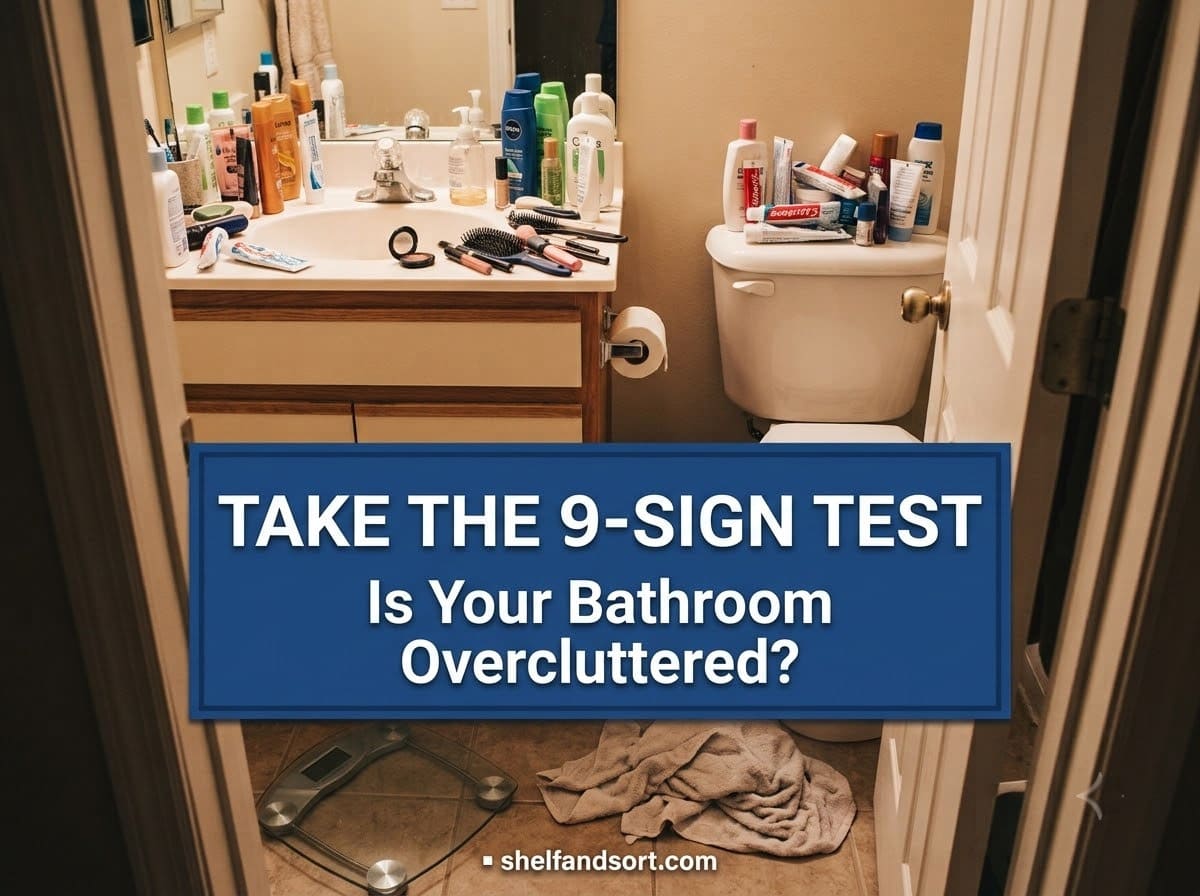
Your bathroom is overcluttered if you can’t name your product backups from memory, something falls out when you open a cabinet, there’s an expired item within arm’s reach, you’ve bought a duplicate because you couldn’t see what you owned, cleaning starts with clearing the counter, the floor is doing storage work, there’s non-bathroom stuff in the room, you have products untouched since last year, or you close the door when guests come.
Give yourself a point for each. Three or more means clutter is winning. The fix is a timed 15-minute sprint: everything off the counter, a fast trash pass, keep one product per job, relocate what isn’t bathroom stuff, wipe and reset. Set an actual timer, because a deadline cuts the decision fatigue that makes bathroom clutter feel impossible to start.
How cluttered is too cluttered?
There’s no rule that says a bathroom can hold 40 items and not 41. The real test is friction, whether the stuff in the room slows down what you’re trying to do in there.
A bathroom that’s a little full but works is fine. A bathroom where you move six things to find your floss, every morning, is costing you time and a small hit of stress twice a day.
So this guide gives you two things. First, a quick 9-sign test to tell whether you’ve crossed from full into overcluttered. Then a timed plan to fix it in one sitting.
This is the do-it-now companion to our piece on what a professional organizer notices first in a messy bathroom. That one is the diagnosis in detail. This one is the sprint.
How do you know if your bathroom is overcluttered?
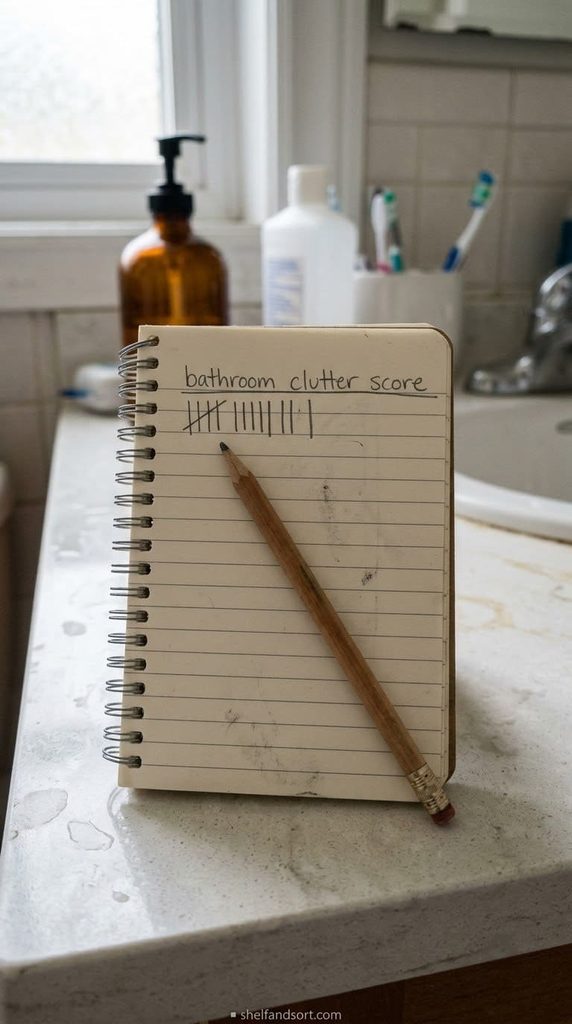
Read each sign below. If it’s true for your bathroom right now, not “sometimes” or “used to be,” give yourself one point. Keep a running total. Your score and what to do with it are in the next section.

1. You can’t name your backups from memory
Try it right now. How many spare rolls of toilet paper do you have? How many unopened tubes of toothpaste? How many backup razors?
If you don’t know within one, you have more than you can track. That’s the line where stocking up turns into hoarding by accident, and it’s where duplicate buying starts.
Quick check: open the cabinet and count. If the real number surprises you, that’s a point.
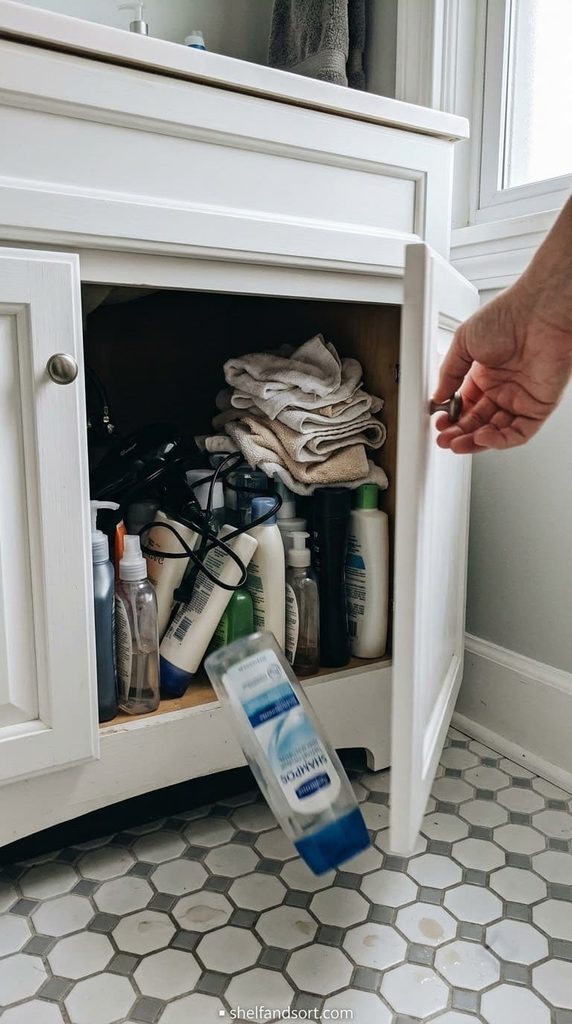
2. Something falls out when you open a cabinet or drawer
A drawer you have to hold shut with one hand. A cabinet where a bottle tips out every time. A shower caddy that drops a razor when you touch it.
Stuff falling out means the space is past full, not near full. You’re storing in a way that fights you.
Quick check: open every bathroom storage spot once. If anything shifts, tips, or falls, that’s a point.
3. There’s an expired product within arm’s reach right now
Not in a box somewhere. Within reach of where you stand at the sink.
The FDA notes that cosmetics can spoil, faster in a bathroom’s heat and damp, and says to toss mascara two to four months after opening. Expired product you keep “just in case” is clutter that also doesn’t work.

After the keep pass, the mixed-size bins turn one vanity drawer into a clear home for your daily items, one bin for oral care, one for skincare, one for hair, so nothing drifts back to the counter. Non-slip feet stop them sliding when you pull the drawer, which is why loose dividers fail.
Shop NowThis post contains affiliate links. We may earn a commission on qualifying purchases at no extra cost to you.
Quick check: grab the nearest three products and check dates or the open-jar symbol. One expired item in reach is a point.
4. You’ve bought a duplicate because you couldn’t see what you had
You bought face wash, got home, and found two nearly full bottles already under the sink. Or you own three of the same lip balm because you kept losing the last one in the pile.
Duplicate buying is the clearest financial sign of clutter. You’re paying twice for the same thing because the first one is buried.
Quick check: has this happened in the last three months? That’s a point.
5. Cleaning the bathroom starts with clearing the counter
Before you can wipe the surface, you have to relocate 12 bottles. So you skip it more often than you’d like, and the counter gets grimy around the clutter.
A bathroom you can’t wipe in one pass is a bathroom that stays dirtier, because the friction makes you clean it less.
Quick check: could you wipe your whole counter right now without moving anything? If not, point.
6. The floor is doing storage work
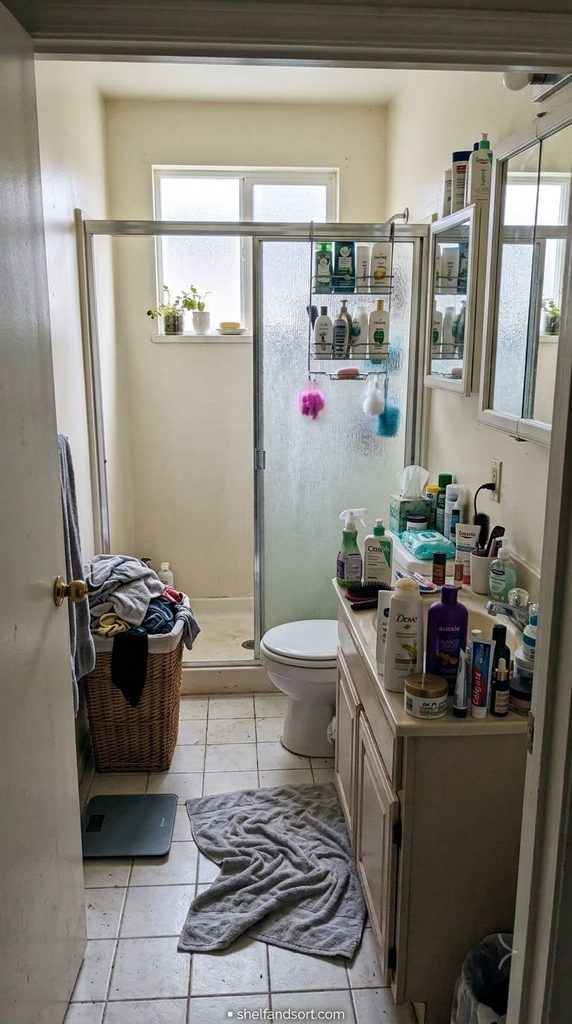
A scale, a plunger, a basket of extra towels, a hair dryer, an overflowing hamper. When the shelves are full, stuff migrates to the floor.
Floor storage in a small bathroom also makes the room read as smaller and messier than it is, and it’s a trip hazard at night.
Quick check: count the items on your bathroom floor that aren’t a rug or a trash can. More than two is a point.
7. There’s stuff in here that isn’t bathroom stuff
Books and magazines. A stack of paper towels for the kitchen. Luggage. Cleaning supplies for the whole house. Gift bags.
The bathroom has the least storage in the house, so anything in there that could live elsewhere is taking space a toiletry needs.
Quick check: look around. If you spot one clear non-bathroom item, that’s a point.
8. You have products you haven’t touched since last year
The hair mask you used once. A sunscreen from a trip two summers ago. A bottle of something a friend recommended that you never opened.
If it’s been a full year, you’re not going to use it. It’s been demoted from “product” to “clutter that looks like a product.”
Quick check: can you find one item you know you haven’t used in 12 months? Point.
9. You close the door when guests come over
Be honest about this one. If your instinct when someone visits is to shut the bathroom door, or apologize before they use it, part of you already knows.
That flash of embarrassment is real data. You don’t feel it about a room that’s just a little full.
Quick check: would you be fine with a guest opening your cabinet to find a spare hand towel? If the answer is no, point.
What your score means
Add up your points. Here’s how to read the total.
| Score | Where you are | What to do |
|---|---|---|
| 0 to 2 | Lived-in, not cluttered | A 2-minute nightly reset keeps it here. No project needed. |
| 3 to 5 | Clutter is creeping in | Run the 15-minute declutter below this week. One session fixes it. |
| 6 to 9 | Overcluttered | Do the 15-minute sprint now for fast relief, then book the 45-minute deep version this weekend. |
Most people land at 3 to 6. That’s not a crisis, it’s a normal drift that a single focused session pulls back. The score is just there to get you to start.
If you scored 6 or higher, skip ahead and start the timer. Reading more about it is its own form of putting it off.
The 15-minute bathroom declutter, minute by minute
Fifteen minutes is short enough to hold your focus and long enough to see the counter clear. Theresa Russell, a home organizer and therapist who founded Homegirl Space, recommends setting a timer and asking of each item whether it adds value to your life or just makes daily life harder.
The timer matters more than it sounds. Bathroom clutter is dozens of tiny “keep or toss” calls in a row, and that’s what wears you out. A deadline caps the decisions.
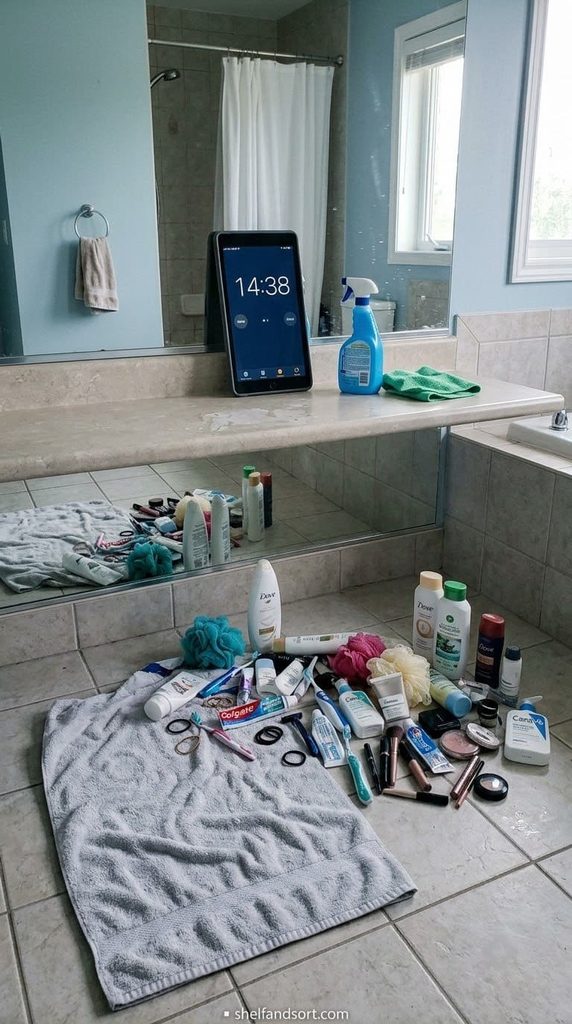
Before you start: grab a trash bag, a “goes elsewhere” basket, and your phone timer. Set it for 15 and go.
| Minutes | Phase | What you do |
|---|---|---|
| 0 to 3 | Empty | Everything off the counter and out of the shower, onto a towel on the floor |
| 3 to 7 | Trash | One fast pass: empty, expired, broken, dried out, gone |
| 7 to 11 | Keep | One product per job goes back, the rest to backstock or the basket |
| 11 to 14 | Relocate | Non-bathroom stuff into the basket, out of the room |
| 14 to 15 | Reset | Wipe the counter, put keepers in their spot, done |
Minutes 0 to 3: empty the surfaces
Move every single thing off the counter and out of the shower onto a folded towel on the floor. Don’t sort yet. Just clear.
Seeing the bare counter is the point. It resets your sense of how much space you actually have.
Common mistake: sorting as you pull things off, one item at a time. That doubles the time and you lose momentum. Clear first, decide second.
Tight bathroom note: use the closed toilet lid or the hallway floor if there’s no room. You need one flat staging area.
Minutes 3 to 7: the trash pass
Now move fast. Into the bag goes anything empty, expired, broken, dried out, or that you can’t identify.
Don’t agonize. Stephanie Denson, founder of the organizing company Spirit & Space, notes on the NAPO blog that the bathroom “almost always has items to purge, from half-empty old bottles to expired products and samples you never used.” Trust that.
Common mistake: keeping a nearly-empty bottle to “use it up.” Five almost-empty bottles take the space of one full one and you still only use your favorite. Bag them.
Kids note: check bath toys for the black mold inside squeeze toys. If it squirts gray water, it’s trash, no debate.
Minutes 7 to 11: keep one product per job
Look at what’s left on the towel. For each job, shampoo, face wash, moisturizer, deodorant, keep the one you actually reach for. One.
Backups go in a labeled bin, not back on the counter. The extras of things you buy in bulk go there too.
Common mistake: keeping two “because one’s almost done.” Finish the open one first. Two open bottles of the same thing is how the counter refills by Friday.
Shared bathroom note: each person gets one small caddy or bin for their keepers. Mixed ownership on an open counter always drifts back to clutter.
Minutes 11 to 14: relocate what isn’t bathroom stuff
Books, extra paper goods, luggage, whole-house cleaning supplies. Into the basket. You’ll carry it out when the timer stops.
Medication too, if you keep it in here. It degrades faster in the humidity, so it belongs in a bedroom drawer or hall closet.
Common mistake: walking each item to its real home as you find it. That breaks the sprint and you end up in another room folding laundry. Basket now, distribute later.
Minutes 14 to 15: wipe and reset
Wipe the empty counter in one pass. Put your keepers back, the four to six daily items on the counter, everything else in a drawer or the cabinet.
If something has no home, don’t force it onto the counter. Set it in the basket with a sticky note and deal with it later. A homeless item on the counter becomes permanent.
Stop when the timer goes off. Carry out the trash bag and the basket. The room is done even if it’s not perfect.
Three versions for the time you actually have
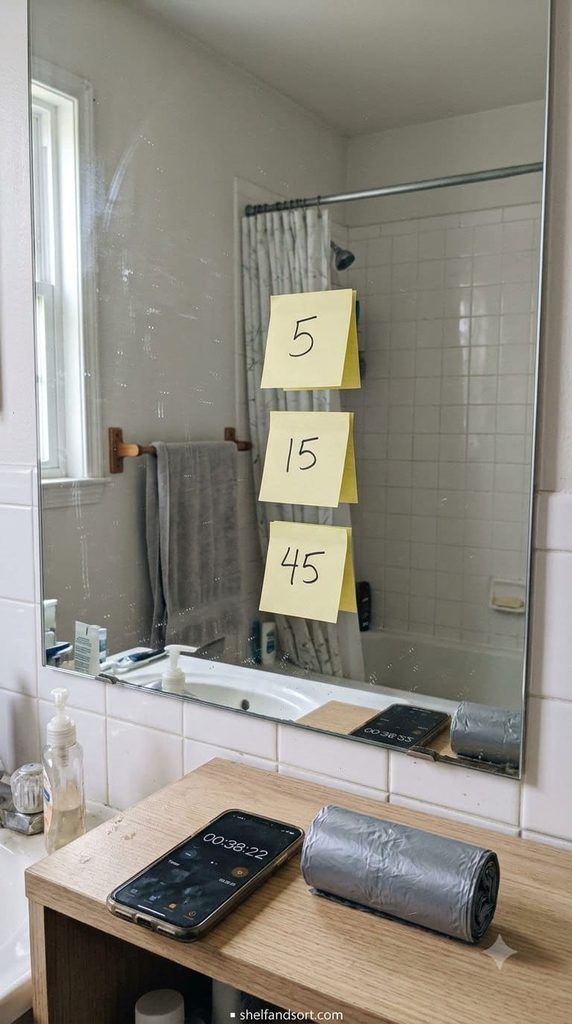
You won’t always have 15 minutes. Match the version to the day.
| Version | Time | What it covers | Best for |
|---|---|---|---|
| Triage | 5 min | Counter and shower only: trash pass plus one product per job | A score of 3 to 5, or company coming in an hour |
| Standard | 15 min | Counter, shower, and the relocate pass, per the plan above | A score of 3 to 5, first real reset |
| Deep | 45 min | Everything above plus every drawer, the under-sink cabinet, the medicine relocation, and a towel thin-out | A score of 6 to 9, or a once-a-season pass |
The triage version is the one to memorize. Five minutes, just the counter and shower, trash and reduce. It won’t fix the drawers, but it makes the room feel 80 percent better and it’s short enough that you’ll actually do it.
The deep version needs its own energy. Do it on a weekend morning, not after work. Pull the entire under-sink cabinet out onto the floor and treat it like its own 15-minute sprint inside the 45.
Overwhelm note: if a score of 6 or higher feels paralyzing, do only the 5-minute triage today. Then do it again tomorrow. Three triage passes in a week gets you most of the way to what one deep session would, with none of the dread.
Why bathrooms re-clutter, and how to stop it
Clearing the room is the easy part. Most people are back to a score of 4 within two months. Four habits cause almost all of it.
The first is buying before checking. You grab shampoo on autopilot because you might be low, and now there are three. The fix is one labeled backstock bin, and a rule that you shop from that bin before the store.
The second is samples and gifts sneaking in. Hotel bottles and gift sets feel rude to toss, so they pile up in a drawer. The fix is that a sample goes straight into your travel pouch or straight into the trash. It never enters a drawer.
The third is items with no assigned home. Anything without a spot lands on the nearest flat surface, and the next thing lands beside it. The fix is that during the reset, every keeper gets one specific spot and goes back there every time.
The fourth is treating the counter as storage. A flat open surface has no limit, so it fills to capacity and stays there. The fix is deciding the counter holds a fixed number, four to six items, and anything past that goes away.
The rule that keeps it clear: one in, one out
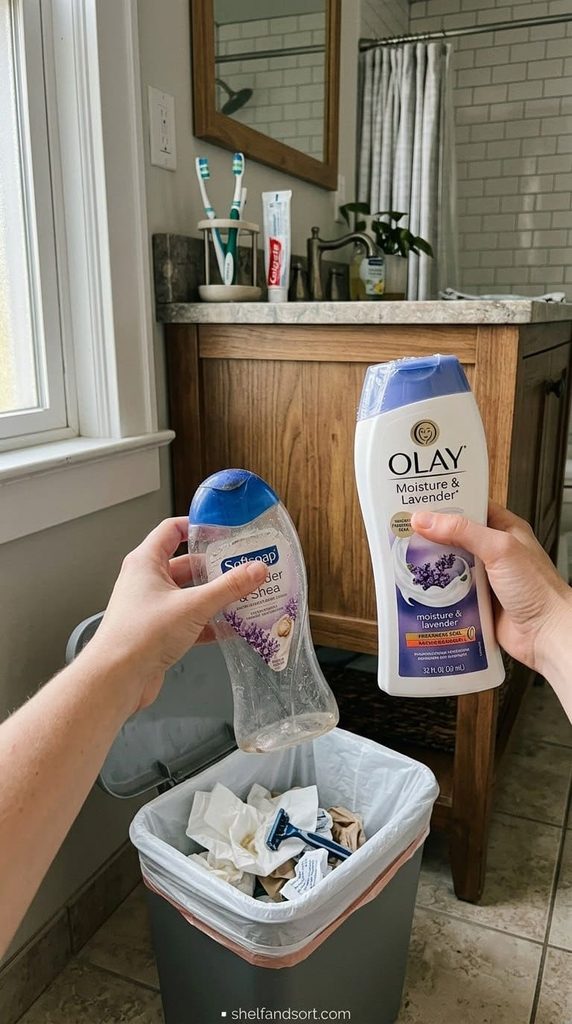
For every new bathroom product that comes in, one leaves. New body wash means the old one gets used up or tossed first. A new towel means an old towel becomes a rag.
The reason it works is that it forces the decision at the moment of purchase, when it’s easy, instead of six months later when the shelf is full and every item feels load-bearing.
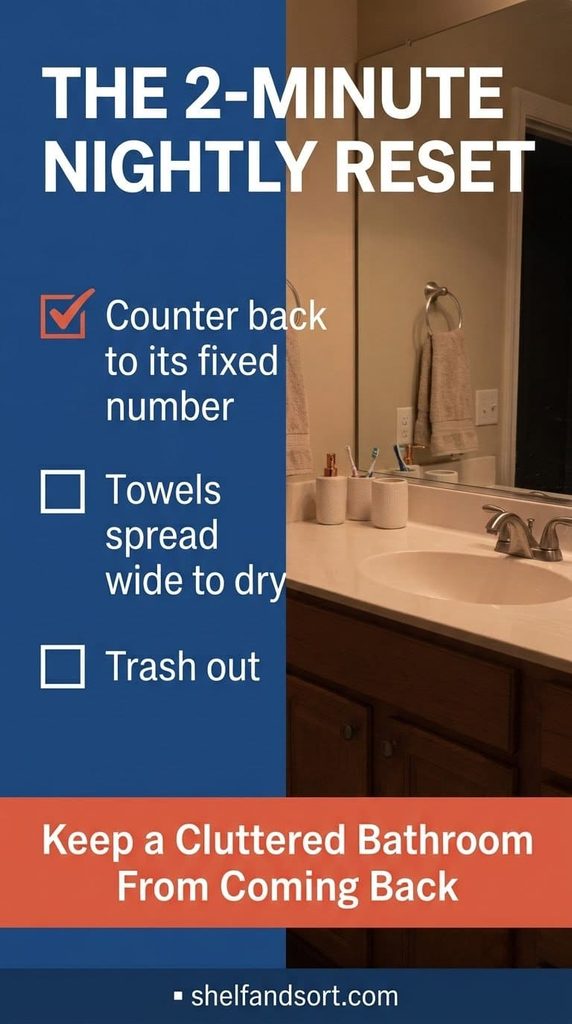
Pair it with a two-minute nightly reset: counter back to its fixed number, towels spread wide to dry, trash out. That’s the whole maintenance system.
Re-run the 9-sign test once a season. If you’re back to 3 or more, do a 15-minute standard sprint. It’s a tune-up, not a project, once the system is in place.
Frequently asked questions
How do I know if my bathroom is too cluttered?
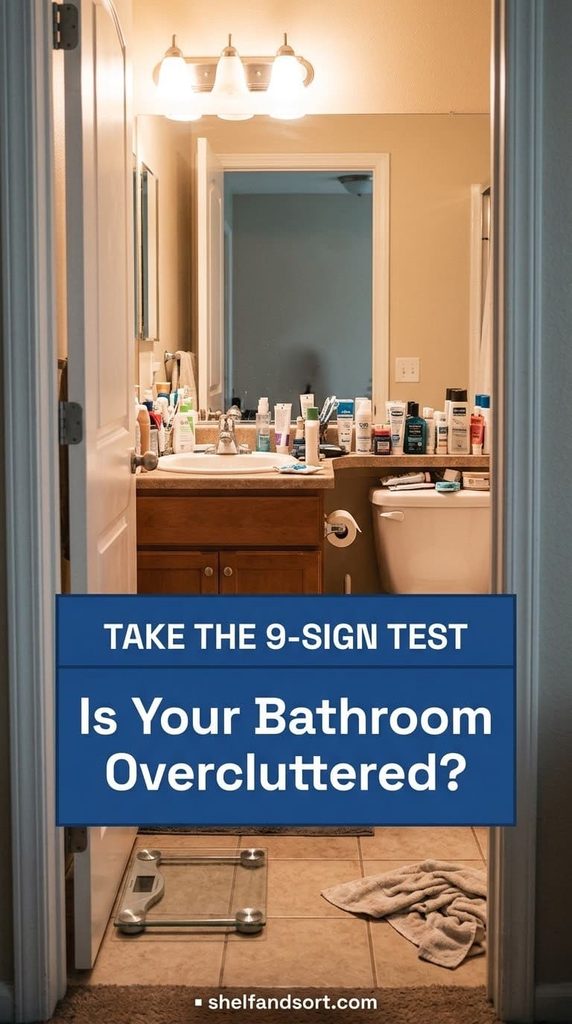
Run the 9-sign test in this guide and give yourself a point for each one that’s true right now: you can’t name your backups, something falls out of a cabinet, an expired product is within reach, you’ve bought a duplicate you didn’t need, cleaning starts with clearing the counter, the floor holds storage, there’s non-bathroom stuff in the room, you have year-old untouched products, or you close the door for guests. Three or more points means clutter is winning and a single 15-minute declutter will pull it back.
How long does it take to declutter a bathroom?
A focused surface-level declutter of the counter and shower takes about 15 minutes with a timer. A triage pass is 5 minutes. A deep version that includes every drawer, the under-sink cabinet, moving medication out, and thinning the towels takes around 45 minutes. The timer is doing real work here, not just tracking time. Bathroom decluttering is dozens of small keep-or-toss decisions in a row, and a deadline limits the decision fatigue that makes the job feel bigger than it is.
What should I get rid of in my bathroom first?
Start with the trash pass: anything empty, expired, broken, dried out, or unidentifiable. The FDA says to toss mascara two to four months after opening, and it degrades faster in bathroom humidity. Then reduce duplicates to one open product per job, with backups moved to a labeled bin. Those two passes clear the most visible clutter in the least time and need almost no hard decisions, which is why they go first.
Where do I start when my bathroom feels overwhelming?
Set a timer for 5 minutes and do only the counter and the shower. Pull everything onto a towel, bag the trash, put back one product per job, and stop when the timer goes off. Don’t touch the drawers or the cabinet today. A 5-minute win breaks the paralysis, and you can repeat it tomorrow. Three short passes in a week get you most of the result of one long session, without the dread that keeps you from starting.
Related posts
- 9 Things Professional Organizers Notice First in a Messy Bathroom. The detailed diagnosis behind the quick test above.
- 11 Things You Should Never Store in the Bathroom. What the humidity wrecks, and where each item belongs instead.
Products We Recommend
This post contains affiliate links. We may earn a commission on qualifying purchases at no extra cost to you.
madesmart Classic 3 Bin Drawer Organizer Set, White
After the keep pass, the mixed-size bins turn one vanity drawer into a clear home for your daily items, one bin for oral care, one for skincare, one for hair, so nothing drifts back to the counter. Non-slip feet stop them sliding when you pull the drawer, which is why loose dividers fail.
Shop Now
Simple Houseware 2 Tier Pull-Out Sliding Drawer Under Sink Storage, White
This is what makes the relocate pass stick. The sliding tiers pull past the vanity door so the P-trap stops eating the back of the cabinet, giving your backstock bin and cleaning caddy an actual spot. Measure the height under your pipe and the door opening before buying.
Shop now
YASONIC Never Rust Shower Caddy, 3-Tier Over Showerhead
For the "one product per job" shower shelf. It hangs over the showerhead with no drilling, good for renters, and the aluminum won't rust like the wire basket it replaces. Three tiers holds one set of products for two people and not much more, so it resists refilling.
Shop now