
9 Things Professional Organizers Notice First in a Messy Bathroom
Professional organizers read a bathroom fast. They are not looking at your tile or your towels, they are looking at where stuff lands when you are in a hurry. This guide breaks down the 9 things a pro notices first in a messy bathroom, the reason each one is a red flag, a specific fix you can do in 10 minutes, and the one maintenance habit that keeps it from creeping back.

Professional organizers notice the same nine things first in a messy bathroom: every flat surface used as storage, a shower wall of half-empty bottles, expired products still in rotation, medicine kept in a steamy cabinet, towels with no assigned job, under-sink chaos around the pipes, empty walls and door backs, a drawer of hotel samples, and daily items mixed in with backstock and cleaners.
Each one is a symptom of the same root problem, no assigned home for things, so items land wherever your hand drops them. The fix is not more bins. It is deciding what actually lives in the bathroom, giving each keeper one spot, and running a two-minute reset most days. Start with the counter, because that is the surface a pro, and every guest, sees first.
How a pro reads a bathroom in five seconds
A professional organizer does not walk in and judge your taste. They scan for friction, the spots where your daily routine keeps breaking down.
Bathrooms are the hardest room in the house for this. They have the least storage and the most small stuff, and almost everything in there is used at speed, half-awake, twice a day.
So a pro looks at where things land. If your contact case is on the windowsill and your razor is on the tub edge, that tells them those items never got a real home. The clutter is just the visible part.
Here is the useful reframe. Every item on this list is fixable in a single short session, and none of the fixes need a shopping trip first. You declutter, you assign homes, then you decide if a bin would help. That order matters, and getting it backward is the single most common bathroom mistake pros see.
Two questions to ask before you touch anything
Run these two questions on the whole room before you start pulling things out. They do most of the sorting work for you.

Question 1: Do I use this in here, at least weekly? Not “could I,” not “someday.” If you use it monthly, it belongs in a linen closet or a hallway cabinet, not prime bathroom real estate. If you never use it, it leaves.
Question 2: Does this item survive heat and humidity? A bathroom swings from 60 percent humidity to steam-room wet twice a day. Medication, extra razor blades, nail polish, and silk anything all degrade faster in that air. Those move out even if you use them daily.
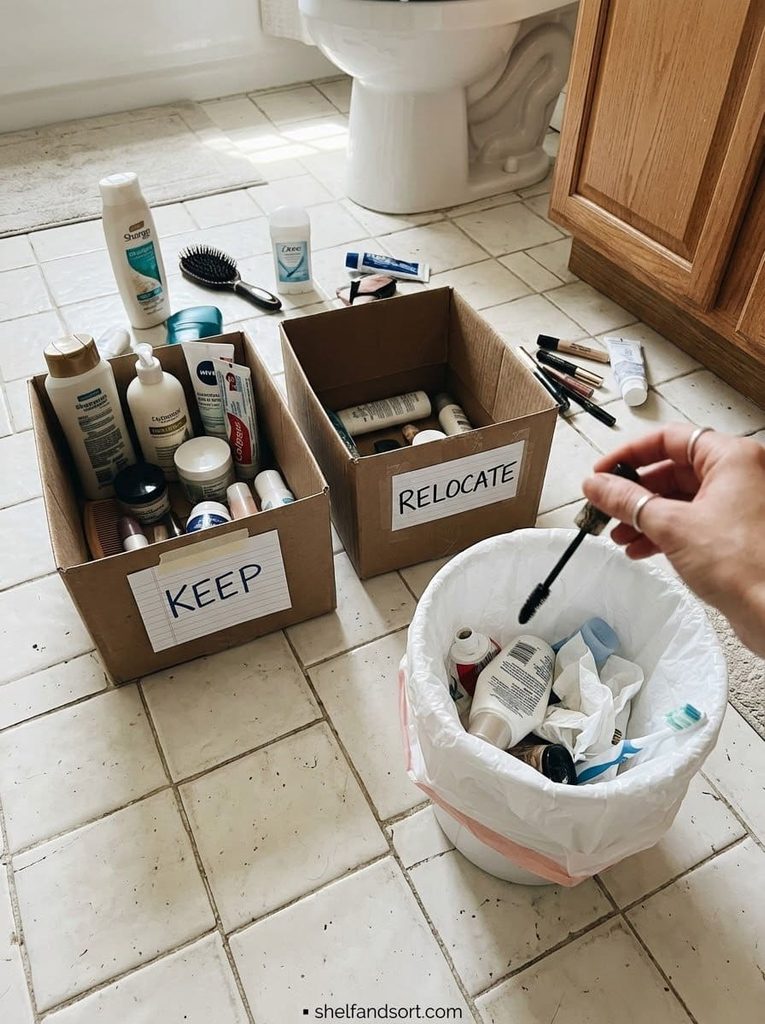
Anything that passes both questions earns one assigned spot. Everything else is either relocated or tossed. Keep a trash bag and a “goes elsewhere in the house” basket next to you the whole time.
1. Every flat surface is being used as storage
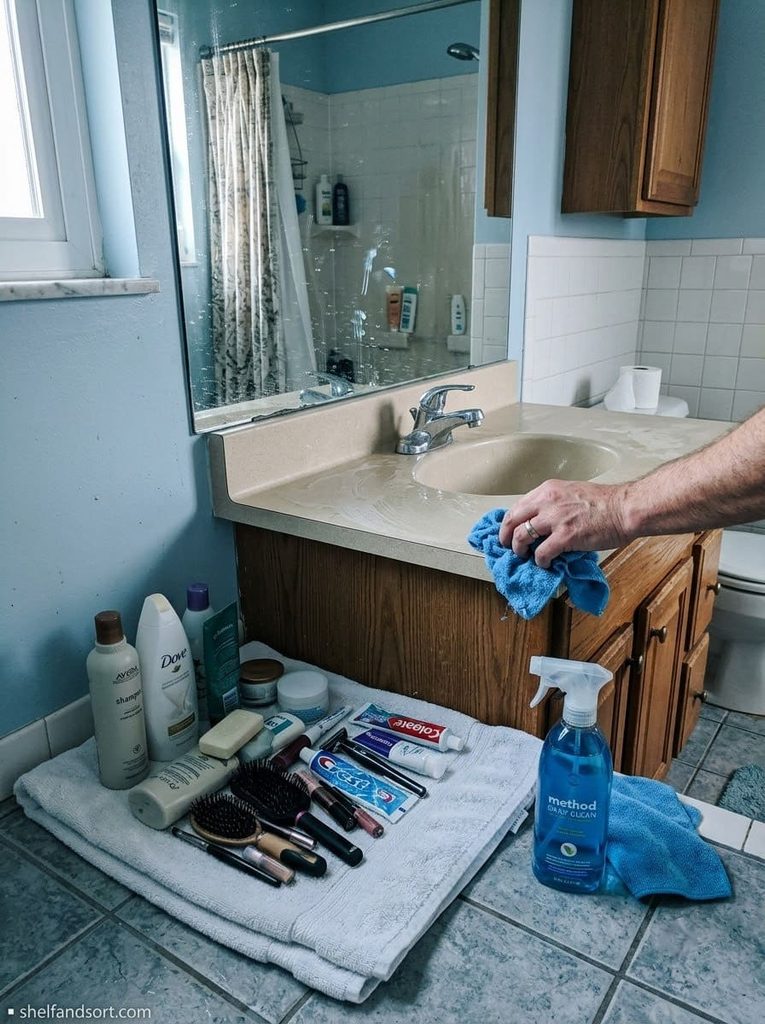
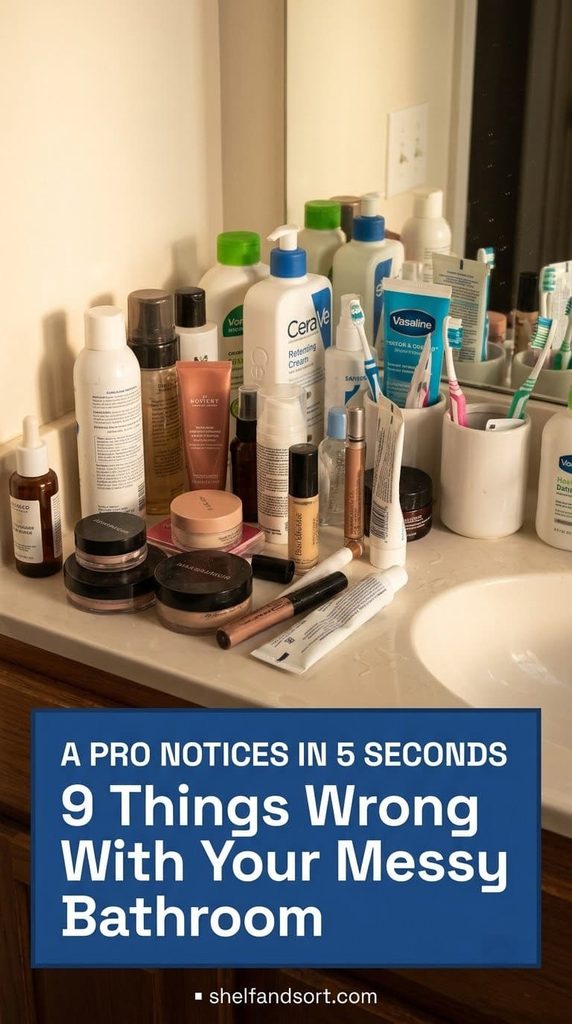
This is the first thing a pro clocks, and it is what guests read as “this house is overwhelmed.” The counter, the back of the toilet, the tub ledge, the windowsill. If it is flat, it has stuff on it.
Flat surfaces feel like free storage because they are already there. But an open surface has no edges and no limit, so it fills until it is full, then it stays full.
The fix, in order: Clear the entire counter onto a towel on the floor. Wipe the counter. Put back only what you touch every single morning, usually that is four to six things. Everything else goes into a drawer, the cabinet, or out of the room. A pro’s target is a counter you can wipe in one pass without moving anything.
The mistake people make: buying a countertop organizer tray first. A tray on a full counter just corrals the clutter at eye level and makes it permanent. Declutter to the four-to-six essentials first, then a small tray for those is fine.
If you only have two minutes: clear just the area around the sink faucet. That is the spot that reads as messiest and gets wet and grimy fastest.

The mixed-size bins turn one deep vanity drawer into the Zone 1 daily-use spot from #9: one bin for oral care, one for skincare, one for hair. Non-slip feet keep them from sliding when you yank the drawer open half-awake, which is the main reason loose drawer dividers fail.
Shop NowThis post contains affiliate links. We may earn a commission on qualifying purchases at no extra cost to you.
Renter or shared bathroom note: give each person one small caddy they can lift out. Shared counters fail when there is no visible line between “my stuff” and “your stuff.”
2. A shower wall lined with half-empty bottles
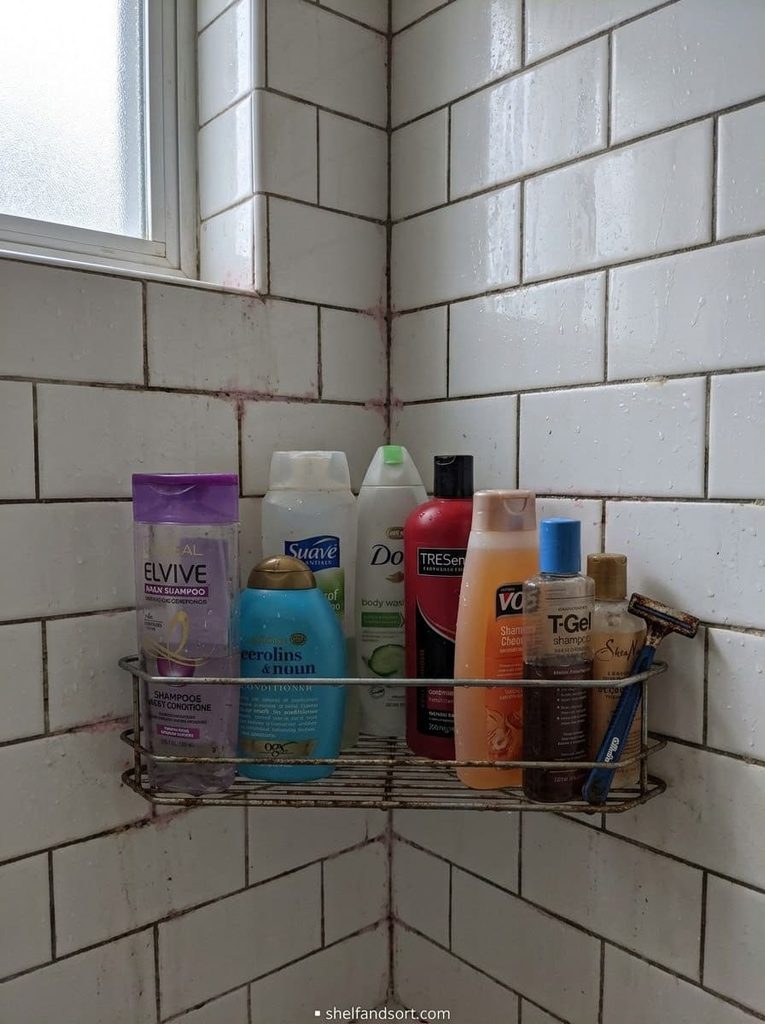
Pros notice the shower shelf immediately, because it is usually a graveyard. Three shampoos, two conditioners you did not like, a body wash from a hotel, a razor going rusty.
Every extra bottle in there is a decision you are re-making every shower, and wet cardboard-and-plastic buildup grows mildew on the bottom ring fast.
The fix, in order: Take everything out. Toss anything empty, expired, or “I tried it once.” Keep one product per job, the one you actually reach for. Put backups in the linen closet, not the shower. Wipe the shelf or caddy while it is empty.
The mistake people make: keeping a not-quite-empty bottle “so it doesn’t go to waste.” Five nearly-empty bottles take the space of one full one and you still use only your favorite. Combine or recycle them.
Two-minute version: just pull the empties and the rust. That alone clears half the shelf most of the time.
Family-with-kids note: kids’ bath products and toys need their own bin that lifts out and drains, not the adult shelf. A mesh bag on a suction hook works and dries between uses.
3. Expired products still sitting in the rotation
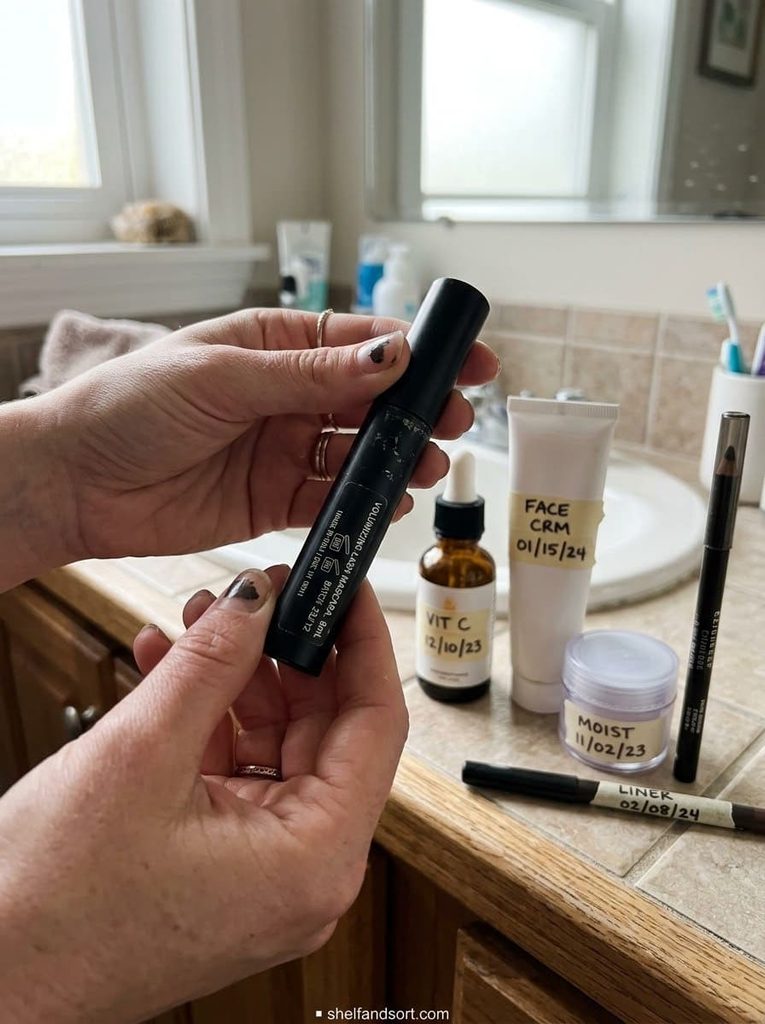
An organizer will pick up a mascara and check the base without thinking about it. Old product is clutter that also does not work, and in the eye and skincare category it can cause real irritation.
Most people have no idea how short these windows are. The FDA notes that cosmetics can go bad, especially “if stored improperly,” and points out that a bathroom’s heat and damp shorten the life of makeup and skincare. It advises tossing mascara two to four months after you open it, sooner if it dries out or smells off.
Look for the small open-jar symbol on the label, the one that says something like “12M” or “24M.” That is the period-after-opening window once the seal is broken.
The fix, in order: Pull every product with a pump, tube, or lid. Write the open date on new items with a marker going forward. Toss anything past its window, anything that changed smell, color, or texture, and any eye product older than three months. Wipe the drawer, put keepers back.
The mistake people make: keeping expensive skincare you spent money on, past its date, out of guilt. Old actives (retinol, vitamin C) do not just stop working, they oxidize and can irritate. The money is already spent either way.
Quick timeline to keep on your phone:
| Product | Toss after opening | Source |
|---|---|---|
| Mascara, liquid eyeliner | 2 to 4 months | FDA |
| Sunscreen | Printed expiration date (it is a drug) | FDA |
| Toothbrush / electric head | 3 to 4 months | American Dental Association |
| Water-based foundation | About 12 months | FDA general guidance |
| Cream and lotion | 6 to 12 months | FDA general guidance |
| Loofah (natural) | 3 to 4 weeks | dermatologist consensus |
The American Dental Association says to swap a toothbrush every three to four months, or sooner once the bristles splay, because a frayed brush cleans worse and holds more bacteria.
If you only have two minutes: just do the eye makeup and the toothbrushes. Those are the two with a real health reason behind the date.
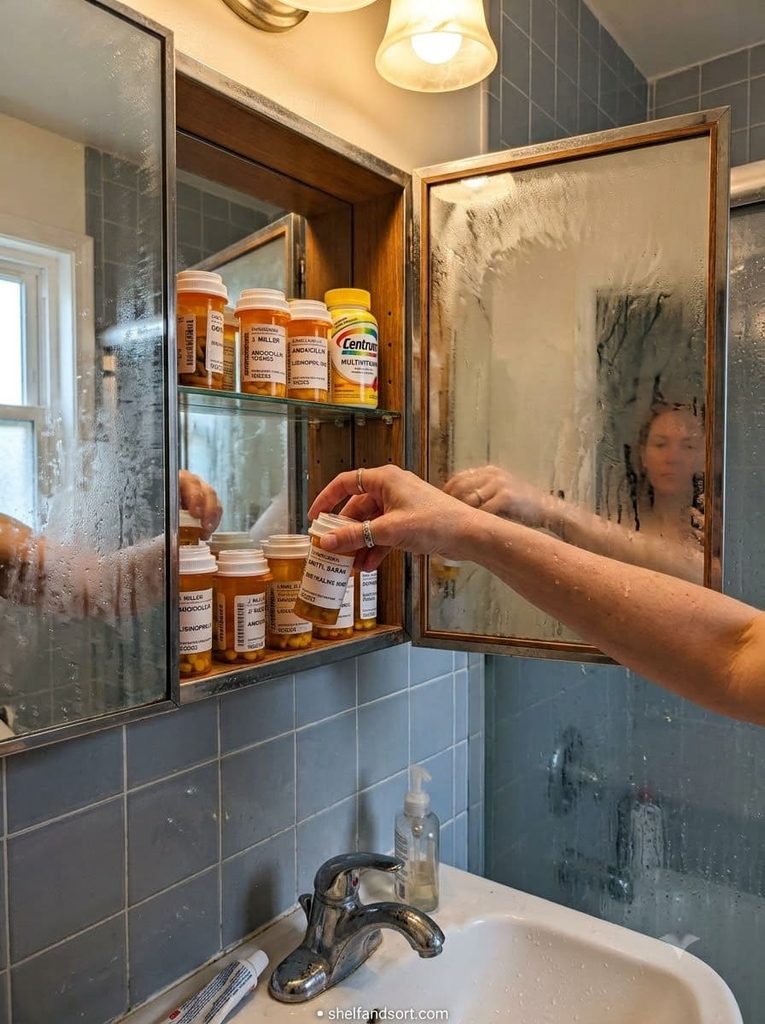
4. Medicine living in the steamy medicine cabinet
This one is almost ironic, and a pro notices it fast. The cabinet is called a medicine cabinet, and it is the worst spot in the house for medicine.
Heat, light, and moisture all break down drugs faster. Selig Corman of the Pharmacists Society of the State of New York put it bluntly to ABC News: “The medicine cabinet in the bathroom is the worst place.” Every shower spikes the humidity right where the pills sit.
Most medication wants a steady room between about 68 and 77 degrees Fahrenheit, per pharmacist guidance, and dry.
The fix, in order: Take all pills, vitamins, and first-aid items out of the bathroom. Move them to a bedroom drawer, a hall closet shelf, or a high kitchen cabinet away from the stove. Keep them in original bottles with the desiccant packet. Put a small first-aid pouch back in the bathroom only if you need bandages at the sink.
The mistake people make: decanting pills into a cute daily organizer and leaving that on the counter. Now they get humidity and light. Fill the weekly organizer from the stored bottle, keep the organizer in the bedroom.
Kids-in-the-house note: relocating meds out of the bathroom is also a safety win, since the bathroom cabinet is an obvious first place a curious kid looks. Put them up high with a latch.
If you only have two minutes: grab just the prescription bottles and move them. Vitamins can wait for the next pass.
5. Towels with no assigned job
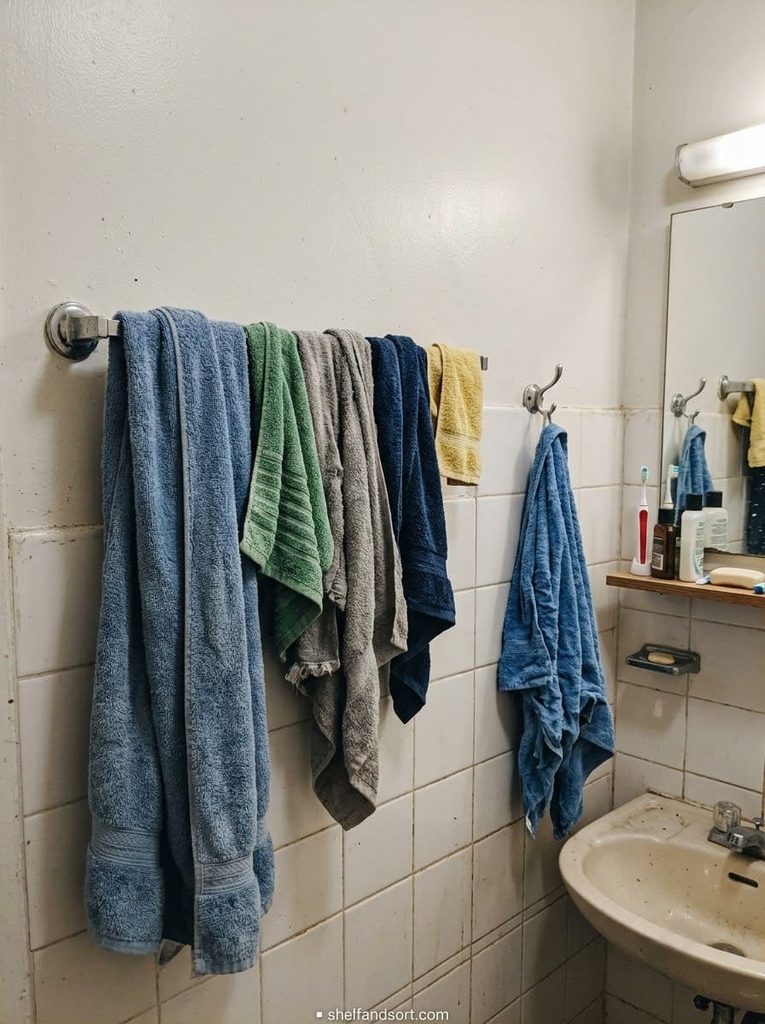
A pro glances at the towel bar and the hooks and reads the whole system in a second. Bath towels, hand towels, and a beach towel all bunched on one bar. A damp towel wadded on a hook. No clear “these are the guest ones.”
When every towel is interchangeable, you end up with more of them than the bathroom can hold, and damp ones never dry because they are stacked against each other.
The fix, in order: Pull every towel out of the bathroom. Keep two bath towels and two hand towels per person who uses that bathroom, plus one guest set. That is it. The rest go to the linen closet, the gym bag, or the rag pile. Give the keepers a real spot: bath towels on the bar, hand towel by the sink, guest set folded in the cabinet.
The mistake people make: hanging a used towel folded in half over a hook. It stays wet in the middle, gets that mildew smell in a day, and then it is laundry instead of a second use. Spread it wide across a bar so it actually dries.
Cleaning pros also flag this: storing your entire towel and linen backstock in the bathroom is a humidity problem. A stack of towels in an open bathroom cabinet absorbs moisture from every shower and can start to smell before you ever use them. Keep only the in-use set in the room.
Renter note: if the bathroom has one sad towel bar, an over-the-door hook rack adds three drying spots without a single hole in the wall.
6. Under-sink chaos packed around the pipes
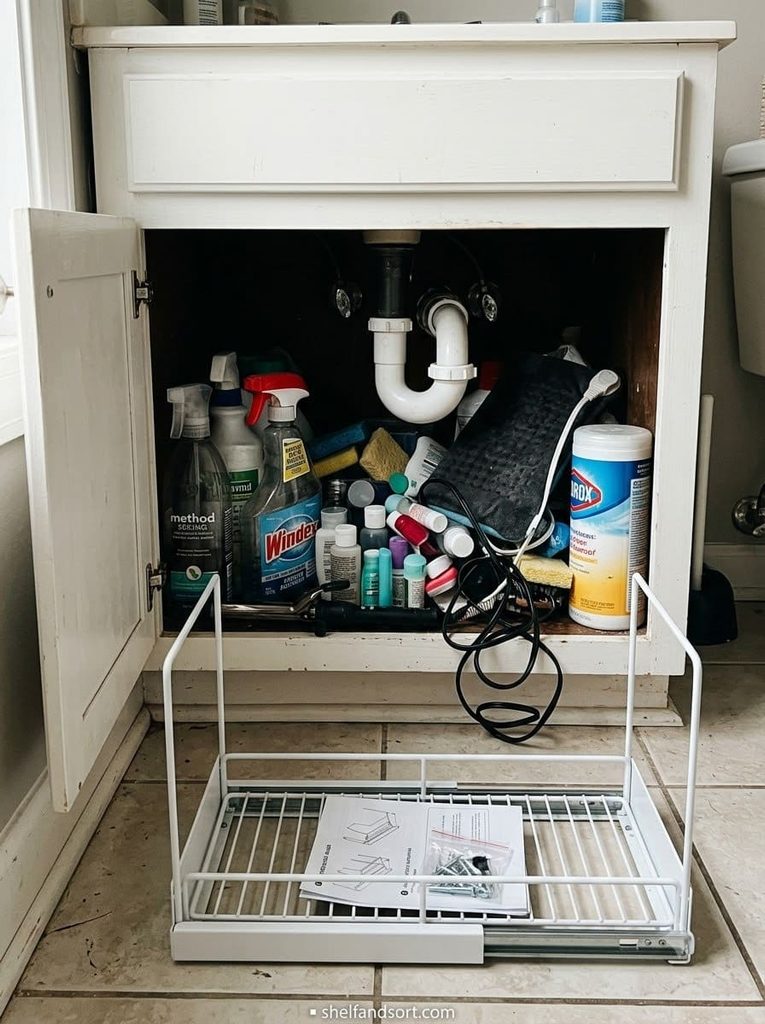
Open the vanity doors and a pro sees it instantly: everything shoved in around the P-trap, nothing stacking, the stuff in back completely lost. Cleaning sprays, backup toilet paper, a heating pad, twelve travel bottles, a curling iron cord.
The pipe in the middle makes this the most wasted storage in the bathroom. Without something to work around it, you only ever use the front four inches.
The fix, in order: Empty the whole cabinet. Toss dried-out sponges, mystery bottles, and anything you forgot you had. Group what is left into three or four categories (cleaning, hair tools, paper backstock, first aid). Use a two-tier pull-out shelf or a couple of bins that slide, so the pipe stops being the boss of the space. Tallest items at the back corners, daily stuff in front.
The mistake people make: buying stackable drawers before measuring the pipe height and the door opening. Half of them do not fit around the trap, or the door will not close on them. Measure width, depth, and the height under the pipe first.
Two-minute version: just pull everything cleaning-related into one caddy with a handle. Being able to lift the whole cleaning kit out in one grab is most of the win.
Budget note: you do not need a matching set. A cheap turntable for bottles and one dish tub you can pull like a drawer covers 80 percent of it.
7. Empty walls and the back of the door
Pros look up. In a messy bathroom, the walls above the toilet, the back of the door, and the side of the vanity are usually blank while every horizontal surface overflows.
Bathrooms are small on floor space but almost always have unused vertical space. Not using it is, in the words of one expert quoted by Homes & Gardens, one of the biggest organizing “icks” they see.
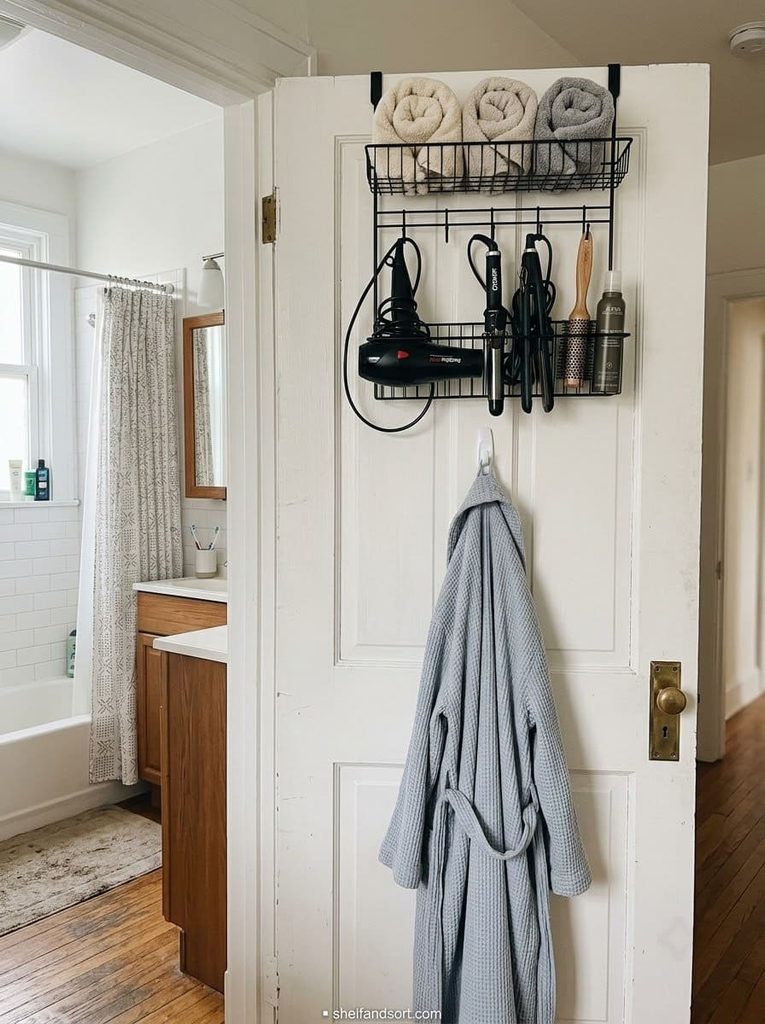
The fix, in order: Identify what is homeless after your declutter, usually extra toilet paper, hair tools, and a hamper. Then match each to vertical space: an over-the-toilet shelf for paper and baskets, an over-the-door rack for tools and robes, adhesive hooks on the vanity side for the hair dryer. Hang the hamper on the door if the floor is tight.
The mistake people make: mounting an over-the-toilet unit that is too shallow, so nothing real fits on it and it becomes a decor shelf. Measure your tallest basket before buying, and get a unit at least 8 to 9 inches deep.
Renter note: over-the-door racks and tension-rod shelves add a full vertical zone with zero drilling. Damage-free adhesive hooks rated for a few pounds handle a hair dryer or a robe.
If you only have two minutes: stick two adhesive hooks inside the door for towels or robes. That clears the two things most likely to end up on the floor.
8. A drawer full of hotel samples and travel sizes
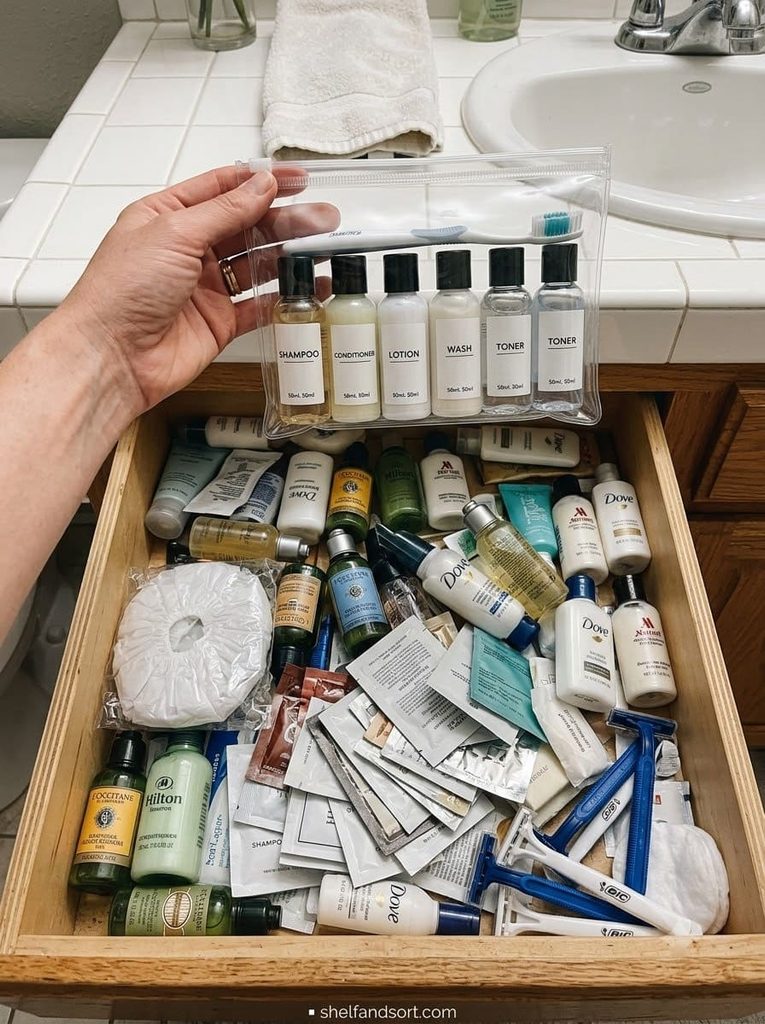
Every organizer has opened this drawer. Forty tiny bottles, a shower cap still in the wrapper, three disposable razors, lotion from a hotel you visited in 2019.
Sample sizes feel too small to bother sorting, so they collect. But they take a whole drawer that a daily-use category needs, and you never actually travel with the random ones.
The fix, in order: Dump the drawer. Keep only what you would genuinely pack for your next trip, be honest, that is maybe eight to ten items. Put those in one clear zip pouch that is your ready-to-go travel kit. Toss anything leaking, separated, or from a brand you would not put on your skin now. Reclaim the drawer for something you use at home.
The mistake people make: keeping samples “to use up at home.” You have a full-size product you like sitting right there, so the sample never gets used. Either use it this week or let it go.
Bookmark tip: keep the travel pouch stocked and sealed in the linen closet, not the bathroom. When a trip comes up, it is already done, and it is not taking bathroom drawer space the other 50 weeks of the year.
Two-minute version: pull just the obvious trash, anything cracked, leaking, or older than you can remember. Sort the keepers later.
9. Daily items mixed in with backstock and cleaning supplies
The last thing a pro notices is a category problem, not a mess exactly. Your face wash sits next to the toilet bowl cleaner. The full pack of nine deodorants is in the same bin as the one you are using. Nothing is zoned.
When daily-use, backstock, and cleaning products all share space, you dig past six things you do not need right now to reach the one you do, every single day.
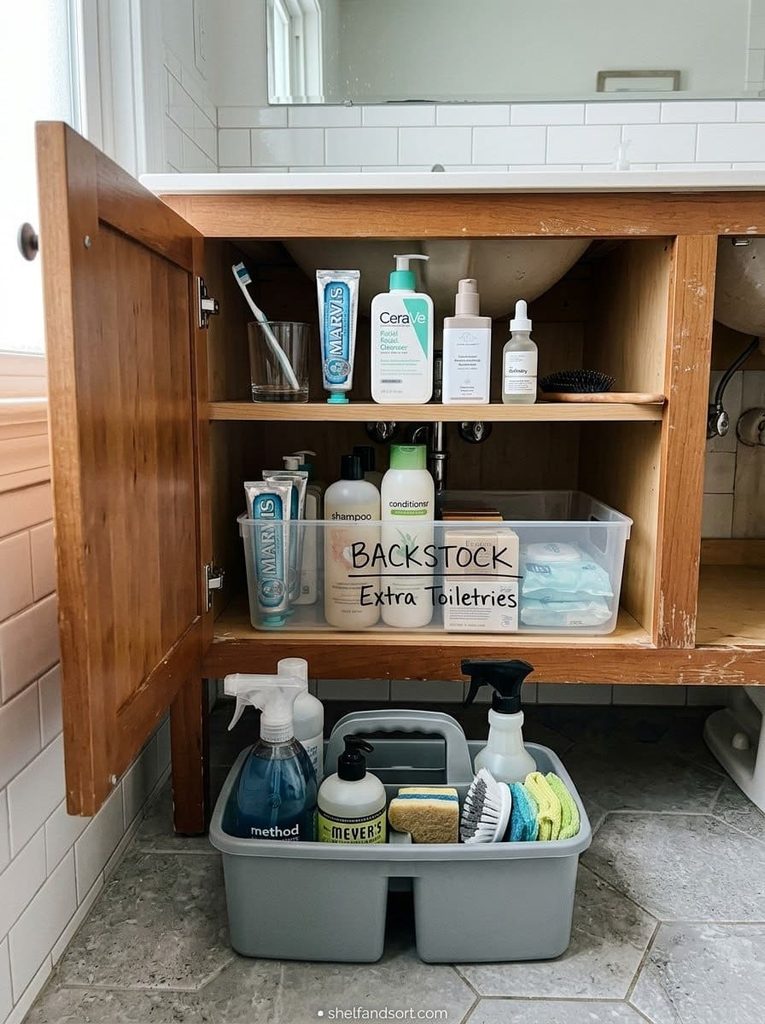
The fix, in order: Sort everything left into three zones. Zone 1, daily use, goes at eye level or in the top drawer, one of each item only. Zone 2, backstock, goes low or high, and holds the extras. Zone 3, cleaning supplies, goes in its own caddy, ideally not touching anything that goes on your face. Label the backstock bin so you actually shop from it before buying more.
The mistake people make: “stocking up” with no backstock zone, so eight bottles of shampoo live in the shower and the vanity and under the sink. You lose track, buy more, and the bathroom runs on overflow. One open, the rest in a labeled Zone 2 bin.
Maintenance note: this is the zone that drifts first. Once a month, pull the daily drawer, put strays back in backstock, and check what is running low. Two minutes, and it stops the slow slide back to chaos.
Family note: in a shared family bathroom, give each kid a single labeled bin in Zone 1. They can find their own stuff, and you can see at a glance who is out of toothpaste.
The one habit that keeps it fixed: the two-minute reset
Organizers will tell you the system is the easy part. The reset is what holds it.
Every night, or most nights, spend two minutes putting the bathroom back to zero. Everything on the counter goes back to its spot. Towels get spread wide to dry. Trash goes out. That is the whole habit.
The reason it works is momentum. A bathroom with four things out gets a fifth added without you noticing. A bathroom at zero makes the fifth thing obvious, so it goes away. You are maintaining a state, not cleaning a mess.
Once a season, do a longer pass: re-check expiration dates, thin the towels again, and pull the under-sink cabinet out to see what crept in. Fifteen minutes, four times a year.
Frequently asked questions
What do professional organizers notice first in a bathroom?
The counter and other flat surfaces. If the counter, toilet tank, and tub ledge are covered in products, a pro reads that as items having no assigned home, so they land wherever your hand drops them. They also quickly check the shower shelf for empty bottles, the medicine cabinet for actual medicine, and under the sink for pipe-crammed chaos. All four point to the same fix: decide what lives in the bathroom, give each keeper one spot, then reset it daily.
How often should you declutter a bathroom?
Do a two-minute reset most nights and a 15-minute deeper pass once a season, four times a year. The seasonal pass is when you re-check expiration dates on makeup and sunscreen, thin the towel collection back down, and empty the under-sink cabinet to catch what accumulated. A full top-to-bottom declutter is usually only needed once, when you first set up the zones. After that, the reset habit does the maintenance.
Why shouldn’t you keep medicine in the bathroom?
Heat and humidity break medication down faster. Every shower spikes the moisture right where pills sit in the cabinet, and most drugs want a steady, dry room between about 68 and 77 degrees Fahrenheit. A pharmacist told ABC News the bathroom medicine cabinet is “the worst place” to store medicine. Move pills and vitamins to a bedroom drawer or a hall closet, keep them in the original bottle with the desiccant packet, and leave only bandages and similar first-aid items at the sink.
What should you actually keep on a bathroom counter?
Only what you touch every single morning, which is usually four to six items: toothbrush and paste, hand soap, face wash, and maybe one lotion. Everything else belongs in a drawer or cabinet. The test a pro uses is whether you can wipe the whole counter in one pass without picking anything up. If you want a tray, add it after you get down to the essentials, not before.
Products We Recommend
This post contains affiliate links. We may earn a commission on qualifying purchases at no extra cost to you.
madesmart Classic 3 Bin Drawer Organizer Set, White
The mixed-size bins turn one deep vanity drawer into the Zone 1 daily-use spot from #9: one bin for oral care, one for skincare, one for hair. Non-slip feet keep them from sliding when you yank the drawer open half-awake, which is the main reason loose drawer dividers fail.
Shop Now
Simple Houseware 2 Tier Pull-Out Sliding Drawer Under Sink Storage, White
This is the fix for #6. The two sliding tiers pull straight out past the vanity door, so the P-trap stops costing you the back half of the cabinet. Measure the height under your pipe and your door opening before buying, since that clearance is exactly what sinks most under-sink organizers.
Shop now
YASONIC Never Rust Shower Caddy, 3-Tier Over Showerhead
For #2. It hangs over the showerhead with no drilling, which suits renters, and the aluminum build does not rust the way the wire baskets it replaces do. Three tiers is enough for one product per job for two people, and not so much that it refills with clutter.
Shop now