10 Things You Should Never Store in the Basement
A basement is the room closest to groundwater, the slowest to dry out after a leak, and usually the most humid space in the house. This guide covers 10 things a basement quietly damages, the number or mechanism behind each one, and where each item belongs instead, plus the one habit that protects almost everything you keep down there.
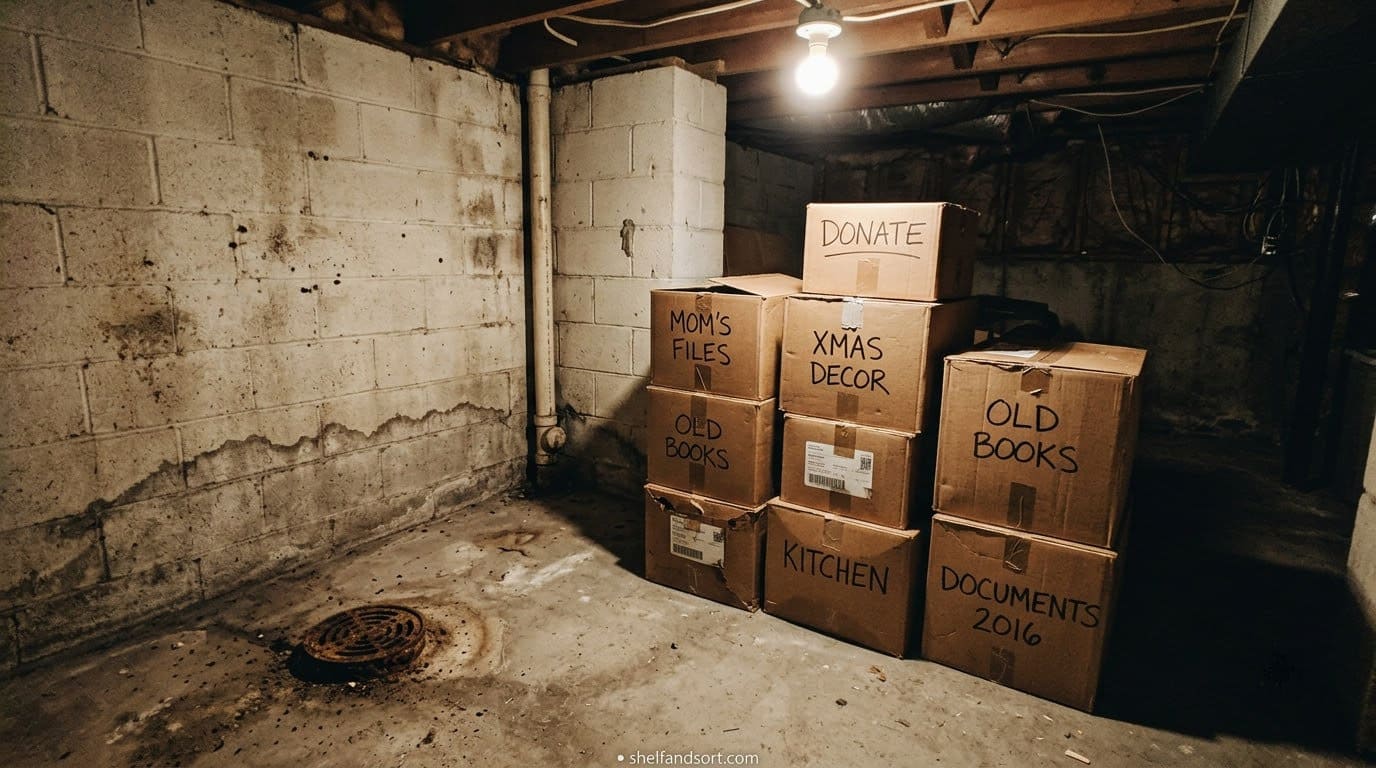
Do not store cardboard boxes of anything, documents and photos and books, clothing and fabrics, wood furniture and antiques, electronics and small appliances, musical instruments, batteries, firearms and bare metal tools, rugs and carpet padding, or anything irreplaceable directly on a basement floor.
The EPA says indoor humidity above 60 percent grows mold within 24 to 48 hours, and most basements sit above that line for weeks at a time even with no visible leak.
Add the real risk of an inch or two of floodwater and the floor itself becomes the most dangerous shelf in the house. The fix is the same for almost everything on this list. Move it to a drier room, switch the container to sealed plastic, and get anything that has to stay at least a foot off the slab.
Two questions to ask before anything goes in the basement
You do not need to memorize a list. Two questions sort almost everything.
First, does the item absorb moisture or grow mold if the air around it stays damp for weeks? Paper, fabric, cardboard, and wood all do, and a basement holds higher humidity than almost any other room without you noticing.
Second, would losing this item to a flood, even a shallow one, actually hurt? Documents, photos, and anything irreplaceable say yes. A leak does not have to be dramatic to reach the bottom shelf.
If either answer is yes, move it up or move it out. Everything else can usually stay if it is off the floor.
How humid does a basement actually get?
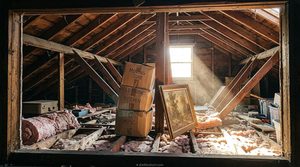
More humid than people realize, because it sits partly below grade against damp soil and gets the least airflow in the house.
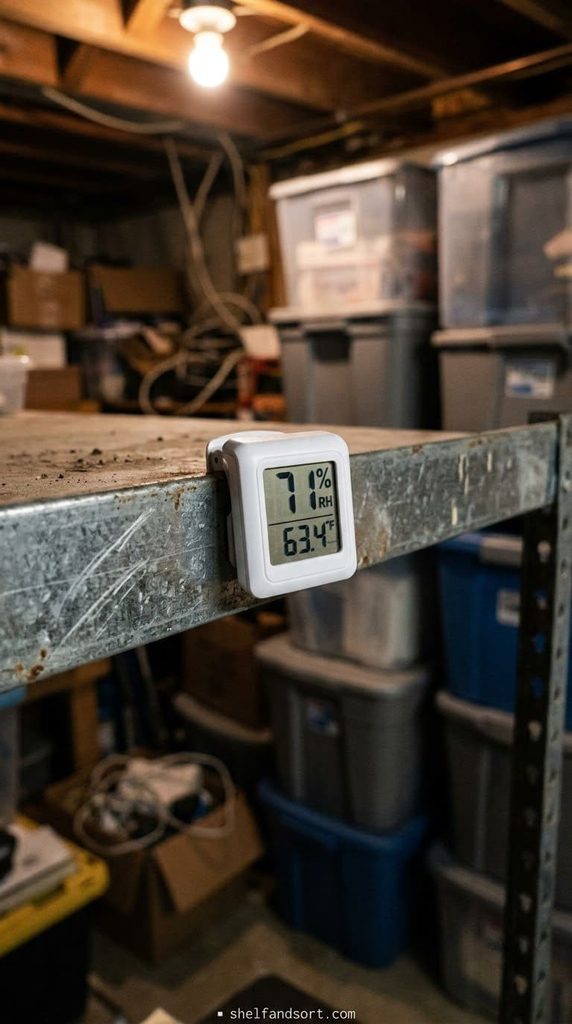
The EPA’s mold guidance puts the target indoor humidity at 30 to 50 percent, and says mold can start growing within 24 to 48 hours once relative humidity passes 60 percent. Basements routinely sit in the 60s and 70s for stretches, especially in summer, with no visible leak at all.
I keep a $12 hygrometer clipped to a basement shelf, and it read 68 percent one muggy August week when the rest of the house sat at 45. That is the gap that quietly ruins a box of stored anything nobody has opened in a year.
What should you never store in the basement?
Here is the full list, the mechanism behind each one, and where it goes instead. The detail on each follows below.
| Item | Why the basement ruins it | Where to put it instead |
|---|---|---|
| Cardboard boxes, any contents | Wicks humidity, weakens, and molds even without a flood | Sealed plastic bins, off the floor |
| Documents, photos, and books | Paper curls, ink bleeds, mold grows in days | An interior closet upstairs |
| Clothing and fabrics | Absorb humidity, attract mold and pests | A closet or cedar chest inside |
| Wood furniture and antiques | Swells, warps, and cracks with damp swings | A dry room, off the concrete |
| Electronics and small appliances | Corrosion on contacts, flood risk to circuits | A closet or spare room upstairs |
| Musical instruments | Wood and glue joints fail with the humidity | An interior room, steady conditions |
| Batteries, loose or installed | Corrode and can leak fumes in high humidity | A dry cabinet at room temperature |
| Firearms, ammunition, bare metal tools | Rust forms fast in damp, unventilated air | A dry safe or cabinet, with a desiccant |
| Rugs, carpet, and padding | Mildew and dust mites grow inside rolled fiber | A dry closet, rolled and elevated |
| Anything irreplaceable, on the floor | The first thing a flood, even a shallow one, reaches | Shelving at least 12 inches up, or upstairs |
1. Cardboard boxes, no matter what is inside
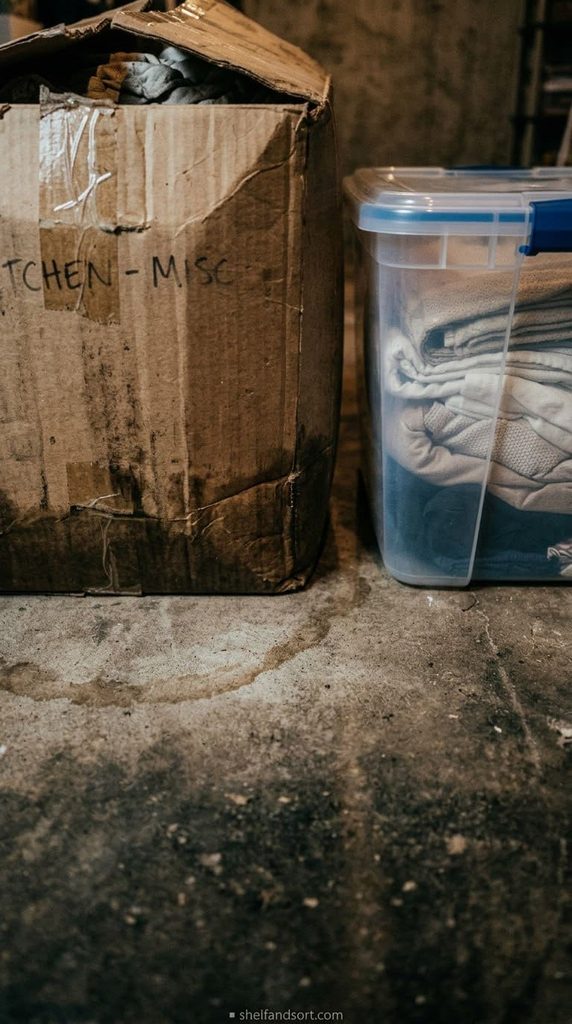
This one is about the container, not the contents. Cardboard is the single most common basement storage mistake, and it fails before whatever is inside it does.
Cardboard is porous, so it wicks ambient humidity straight out of the air, gets soft, and loses structural strength over months. Once it is damp, it is also exactly what mold spores want to grow on, and a stack of boxes gives them a head start even without standing water.
Lisa Zaslow, a professional organizer and founder of Gotham Organizers, points to basement humidity as the reason porous materials like cardboard, paper, and fabric are the first things to fail down there.

The same sensor that tracks a garage's overnight low also works as a rough basement check when paired with the humidity display some models include, or as a temperature reference alongside a separate hygrometer.
Shop NowThis post contains affiliate links. We may earn a commission on qualifying purchases at no extra cost to you.
Do this: move everything from cardboard into clear, sealed plastic bins with locking lids before it goes anywhere near a basement.
Common mistake: reusing moving boxes for long-term basement storage because they are already there and free. A box built for a one-time move was never meant to sit on a slab for three years.
Short on time: transfer the boxes holding paper or fabric first, since those contents fail fastest once the box itself gives out.
Bookmark tip: label plastic bins on the side, not just the top, so you can read the label from across the room without pulling every bin down first.
2. Documents, photos, and books
The filing cabinet of old tax records and the box of family photos feel safe in a locked basement. Paper is the worst possible material for that environment.
Humidity curls pages, bleeds ink, and warps photo prints, and mold can start on paper within 24 to 48 hours once the room passes 60 percent relative humidity, per the EPA’s mold guidance cited above. Books swell at the spine and the pages fuse if it gets bad enough.
Do this: move important paper, tax records, and photos to an interior closet upstairs, in a sealed bin, not a filing box.
Common mistake: storing the fireproof document box on the basement floor because “fireproof” sounds like enough protection. Fireproof boxes are rarely watertight, and a flood ruins the contents just as fast as fire would have.
Short on time: grab anything irreplaceable first, birth certificates, the deed, family photos with no backup copy.
Bookmark tip: scan the truly irreplaceable documents and photos to the cloud. A ruined physical copy stops being a total loss once a digital one exists.
3. Clothing and other fabrics
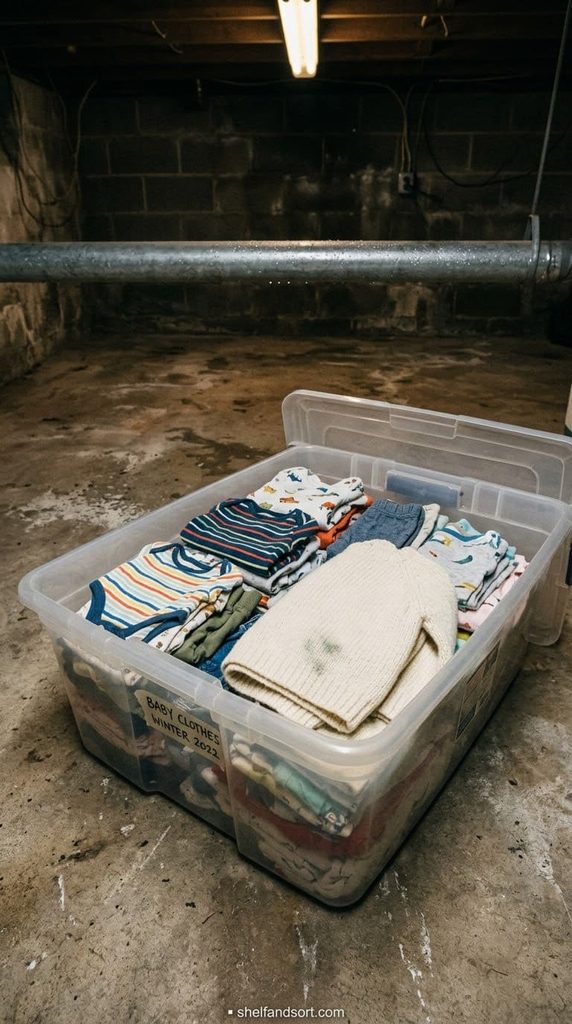
Off-season coats, baby clothes you are saving, the box of old bedding. Fabric absorbs moisture the same way paper does, just a little slower.
Once damp, fabric is a magnet for both mold and moths, and a basement gives both a stable, undisturbed place to work for months before anyone checks the box.
Do this: move clothing and fabric to an upstairs closet or a cedar chest, somewhere you would also be comfortable sleeping.
Common mistake: vacuum-sealing clothes for basement storage and assuming that solves it. A vacuum bag blocks air but not a flood, and a small leak under the seal defeats the whole point.
Variant note: wool and other natural fibers are the most pest-prone of the group. A few cedar blocks in the storage bin help if cedar chest space is not available.
Bookmark tip: wash items before long-term storage. Body oil and residue attract moths more than the fabric itself does.
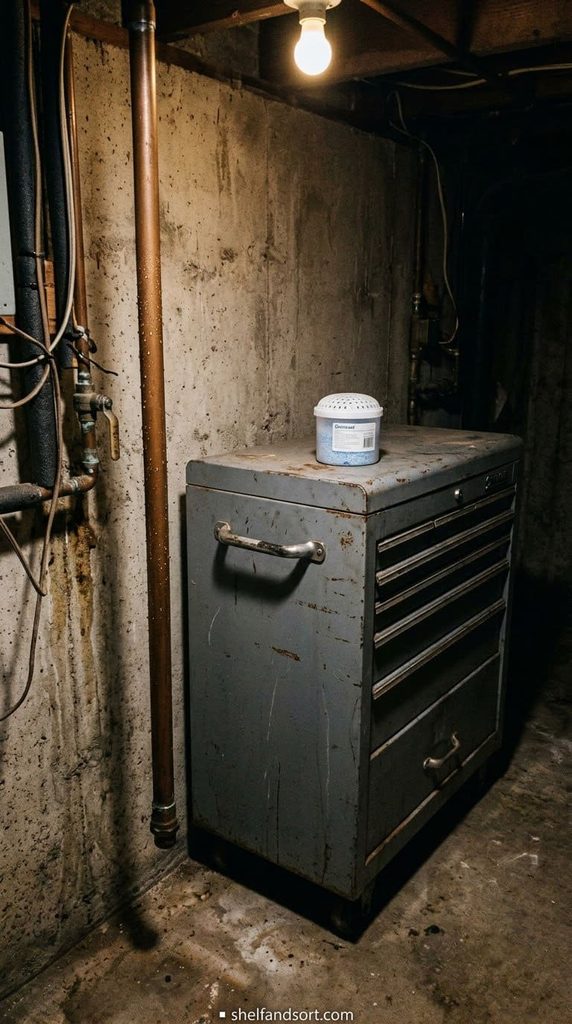
4. Wood furniture and antiques
An old dresser or a family heirloom table looks solid enough to survive down there. Wood is more sensitive to a damp environment than it looks, and antiques even more so.
Wood absorbs moisture and swells, then dries and cracks when the basement’s humidity swings, and joints glued decades ago let go faster than newer construction. A piece resting directly on a concrete floor also wicks moisture straight up through its legs.
Do this: keep wood furniture and antiques in a dry room upstairs, or at minimum on furniture risers or a pallet, never flush against the concrete.
Common mistake: covering furniture in plastic sheeting to “protect” it in the basement. Plastic traps whatever humidity is already there against the wood, which speeds up the damage instead of slowing it.
Variant note: a genuine antique or a piece with real sentimental value deserves an upstairs spot, full stop. The basement is for furniture you would not be devastated to lose.
Bookmark tip: a coat of furniture wax on exposed wood surfaces before any temporary basement stay adds a thin moisture barrier that helps in a pinch.
5. Electronics and small appliances
The spare TV, an old laptop, a countertop appliance you are not using right now. All three are a bad match for a basement.
Humidity corrodes the small metal contacts inside a device over time, and a basement carries the added risk that a flood, even a shallow one, reaches an outlet-height shelf faster than anywhere else in the house.
Do this: store electronics and small appliances you plan to reuse in a closet or spare room upstairs, unplugged.
Common mistake: leaving electronics plugged into a basement outlet “just in case,” which adds a real shock and fire risk if water ever reaches that outlet or the cord.
Short on time: anything with a screen, a circuit board, or a battery comes up first. Cables and cords can wait.
Bookmark tip: if a device has been in a damp basement, let it sit unplugged in a dry room for a few hours before you power it on, so any trapped moisture has time to clear.
6. Musical instruments
A guitar in a case or an old piano feels tucked away safely in a basement corner. Instruments are some of the most humidity-sensitive things people store anywhere in the house.
Wood expands and contracts with humidity swings, which cracks tops, loosens glued joints, and pops seams, and a case slows that process without stopping it over months of basement storage.
Do this: keep instruments in an interior room upstairs with stable humidity, ideally with a small hygrometer nearby to confirm it.
Common mistake: storing an instrument case directly on a basement floor, where it picks up ambient moisture from the concrete slab even without a leak.
Short on time: move the most valuable or hardest-to-replace instrument first. A backup practice guitar tolerates more risk than a family heirloom violin.
Bookmark tip: a few silica gel packets tucked into a closed instrument case add a cheap layer of moisture protection if the instrument has to spend any time in a marginal space.
7. Batteries, loose or installed
A drawer of spare AA and AAA batteries, or a device left with its battery still inside for storage. Batteries and basement humidity are a bad pair.
High humidity over time can corrode battery terminals and, in some chemistries, cause internal leaks that release fumes, and a basement’s stable damp air gives that process months to work uninterrupted.
Do this: store loose batteries and battery-powered devices in a dry cabinet at normal room temperature upstairs.
Common mistake: leaving batteries installed in seasonal devices, like a flashlight or a decoration, that only get used once a year. Remove batteries from anything going into storage for months at a time.
Variant note: rechargeable and lithium batteries deserve the same treatment as regular ones here, dry and at room temperature, though their specific cold-weather rules are a separate concern from basement humidity.
Bookmark tip: keep a small bin of loose batteries with a written expiration check date on the lid, so you are not guessing which ones are still good when you finally need one.
8. Firearms, ammunition, and bare metal tools
A basement gun cabinet or a box of hand tools seems like a natural fit for a utility space. Bare metal and constant damp air do not get along.
Rust forms fast in an unventilated, humid basement, and it works on ammunition casings and firearm mechanisms the same way it works on any exposed steel, quietly and continuously.
Do this: store firearms in a dedicated safe or cabinet with a desiccant pack or a small dehumidifier rod, and follow your local storage and safety laws for firearms specifically.
Common mistake: storing tools loose on an open basement shelf instead of in a closed toolbox or cabinet. The open shelf gets the full humidity swing, while a closed container buffers it somewhat.
Variant note for households with kids: basement gun storage should meet your state’s safe-storage requirements regardless of humidity concerns, locked and separate from ammunition, since that safety rule matters more than the rust risk.
Bookmark tip: a light coat of gun oil or tool oil on exposed metal before storage adds a real barrier against basement humidity between uses.
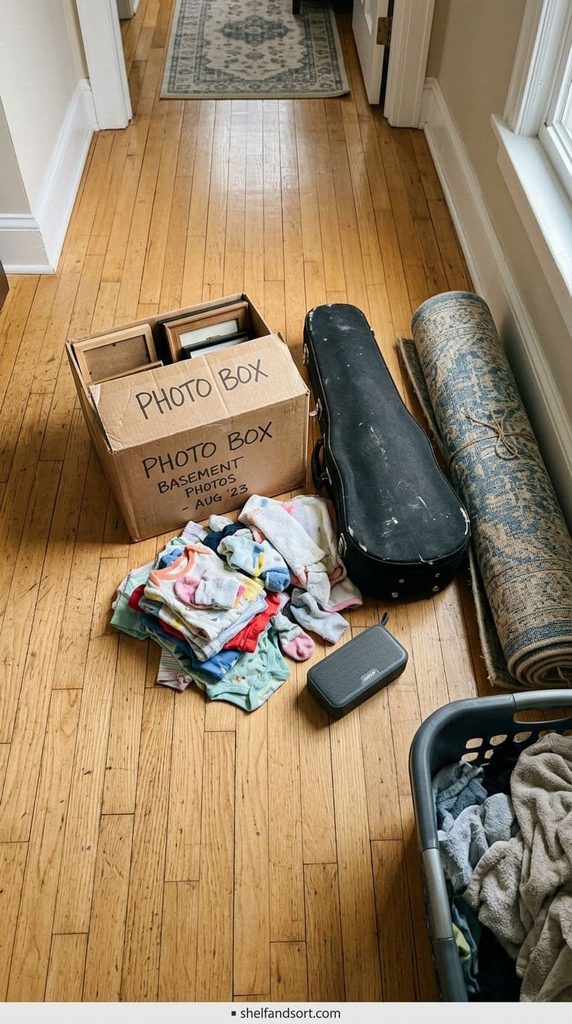
9. Rugs, carpet, and padding
A rolled-up area rug from a past redecorating project seems harmless leaning in a basement corner. Rolled fiber traps moisture inside itself in a way flat storage does not.
Mildew and dust mites thrive in the damp, dark interior of a tightly rolled rug, and by the time you unroll it for use again, the smell and the staining are often already set in.
Do this: store rugs in a dry interior closet, rolled loosely rather than tightly, and elevated off any floor.
Common mistake: rolling a rug in plastic wrap for basement storage. Plastic seals moisture inside the roll rather than keeping it out, which is worse than no wrap at all.
Short on time: if a rug has to stay in the basement short term, at minimum stand it upright rather than lying it flat, and keep it off the concrete on a couple of wood blocks.
Bookmark tip: a breathable cotton sheet wrapped around a rolled rug protects it from dust without trapping moisture the way plastic does.
10. Anything irreplaceable, stored directly on the floor
This one is not about a category of object. It is about the single riskiest habit in basement storage, and it applies to everything on this list plus anything else you keep down there.
A basement floor is the first surface a flood reaches, and it does not take a dramatic event. An inch or two of water from a sump pump hiccup or a washing machine hose failure ruins everything sitting flush against the slab before anyone notices. FEMA’s flood-protection guidance recommends elevating stored belongings on shelving well above the floor, the same logic used for mechanical equipment near a flood line.
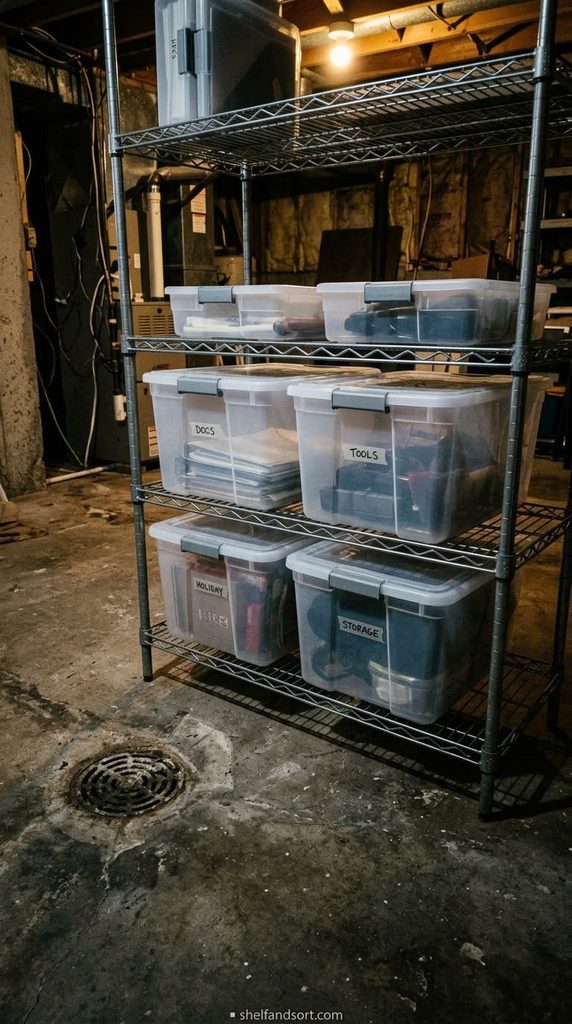
Do this: get everything you keep in the basement onto real shelving, at least 12 inches off the concrete at a minimum, higher for anything irreplaceable.
Common mistake: stacking bins two or three high directly on the floor and calling it organized. Height off the floor is what protects the contents, not how neatly the stack is arranged.
Short on time: at minimum, walk the basement and pull anything irreplaceable up onto the lowest shelf you have today. A full shelving system can wait, a flood cannot.
Bookmark tip: a cheap set of wire shelving units from a hardware store solves this for most of a basement in an afternoon, and it costs far less than replacing what a shallow flood would ruin.
What is actually fine to keep in the basement
The goal is not to empty the basement. Plenty of things handle the conditions fine.
Sealed plastic bins with hard plastic contents, seasonal decor that is not fabric or wax, camping gear built for damp conditions, canned goods on a shelf well off the floor, and tools in a closed metal box all generally hold up.
The washer, dryer, water heater, and other mechanical equipment obviously belong there too. The test is the same two questions from the top: does it absorb moisture or mold, and would losing it to a shallow flood actually hurt. If both answers are no, the basement can hold it.
The basement humidity check, your once-a-year maintenance rule
Most basement damage happens slowly enough that nobody notices until they open a box. One habit catches it early.
Set a reminder once a year, ideally after the wettest season in your area, to walk the basement with a flashlight and a cheap hygrometer. Check the reading, look for any new water stain or musty smell, and confirm nothing sits flush on the floor.
It takes about 15 minutes. Catch the humidity creeping up or a box sitting where it should not be, and you fix it before it becomes a ruined photo album or a moldy rug instead of after.
Frequently asked questions
What should you never store in the basement?
Cardboard boxes of anything, documents and photos and books, clothing and other fabrics, wood furniture and antiques, electronics and small appliances, musical instruments, batteries, firearms and bare metal tools, rugs and carpet padding, and anything irreplaceable stored directly on the floor. Most of these fail because basement humidity regularly exceeds the 60 percent threshold where mold starts growing within 24 to 48 hours, and the rest fail because the floor is the first place a flood reaches. Switch to sealed plastic bins, elevate everything at least 12 inches, and move anything irreplaceable upstairs.
How humid does a basement actually get?
More than most people realize. The EPA recommends keeping indoor humidity between 30 and 50 percent, and says mold can start growing within 24 to 48 hours once relative humidity passes 60 percent. Basements, being partly below grade with limited airflow, commonly sit in the 60s and 70s for stretches, especially in summer, even with no visible leak. A cheap hygrometer left on a basement shelf for a week shows your real number.
Can you store cardboard boxes in the basement?
Not safely for long-term storage. Cardboard is porous and wicks humidity straight out of the air, which weakens the box structurally and makes it an easy surface for mold to grow on, even without standing water. Switch to clear, sealed plastic bins with locking lids for anything staying in the basement more than a few weeks.
How far off the floor should basement storage be?
At least 12 inches, following the same elevate-above-flood-line logic FEMA recommends for basement mechanical equipment. A shallow flood from a sump pump failure or a burst hose can reach an inch or two of the floor without much warning, and anything sitting flush against the concrete is the first thing it ruins. Real shelving, not stacked bins on the ground, is what actually protects the contents.
Is it safe to store important documents or photos in the basement?
No, even in a sealed container. Paper degrades fast in high humidity, curling, bleeding ink, and growing mold within days once the room passes 60 percent relative humidity, and a basement flood destroys paper faster than almost anything else stored down there. Keep documents and photos in an interior closet upstairs, and scan anything irreplaceable as a backup.
Products We Recommend
This post contains affiliate links. We may earn a commission on qualifying purchases at no extra cost to you.
AcuRite 02049 Indoor/Outdoor Wireless Thermometer
The same sensor that tracks a garage's overnight low also works as a rough basement check when paired with the humidity display some models include, or as a temperature reference alongside a separate hygrometer.
Shop Now
IRIS USA WeatherPro 19-Quart Gasket-Lid Storage Bins, 6-Pack
The direct swap for the cardboard boxes on this list. The gasketed lid keeps out the ambient humidity that ruins paper, fabric, and cardboard itself, and the bins stack cleanly on real shelving.
Shop now
Attic Dek Flooring Storage System, 4-Panel Kit
Built for attic joists, but the same interlocking panels work as a raised platform over a basement floor drain or a damp slab corner, keeping bins off the concrete without a full shelving install.
Shop now